Not the best news, but not the worst
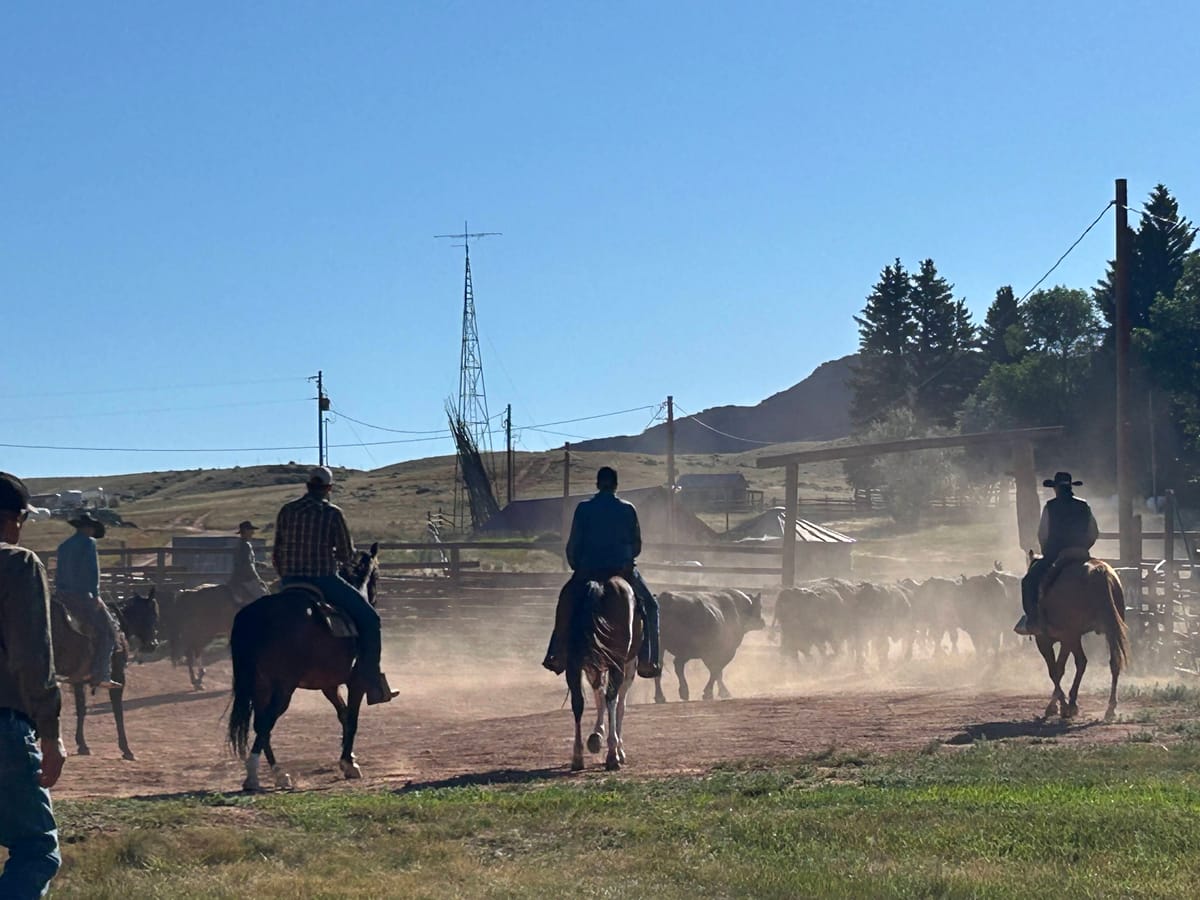
I just got back in town today after a week in WY at our family ranch, Willow Creek Ranch at the Hole in the Wall. Ranching is tough work, and summers at the ranch are packed with so much to do - branding calves, docking lambs, feeding bum lambs and calves (the runts and orphans from the spring), and moving hundreds of bulls, cows and calves up to their summer pasture. Part of what brought us to Denver originally was our desire to be closer to Kate's family and the ranch. We don't get up as often as we like, but we always prioritize make time during the summer to get up to help out however we can. So with Kate still recuperating and both boys working summer job, it was up to me to pull the weight of the Redden family during one of the ranch's busiest weeks! It wasn't the same without Kate there this year, but the show - or at least the cows - must go on. I'm dead tired, but it was a great week, mostly.
I was helping with dinner last night when I felt my phone buzz, which is unusual from the cookhouse, because there's no Wi-Fi and you only occasionally get a stray cell signal. This is one of the best features of the ranch in my opinion - lots of disconnected time! 😜 The text was from Kate and it was a PDF with her pathology report and the message, "Not exactly what I wanted to hear."
I beelined it from the cookhouse to the corral (where the bulls are headed in the picture) because you can usually get a Wi-Fi signal from the main house. I downloaded the PDF and didn't bother to try and read it. I just sent it straight to AI: "Kate just got her pathology report back after her mastectomy. I want you to provide a summary and an understandable analysis. No fluff or BS, tell us straight what this says and what it means." Here's what it told me:
Left breast: no cancer. Benign findings only — atypical lobular hyperplasia, some fibrocystic changes, calcifications. Negative for anything malignant. That side is clean.
Right breast: invasive lobular carcinoma, confirmed.
Multifocal — at least 3 separate tumor spots, not one mass. Largest is 28.5mm (about 1.1 inches), other two are small (4.7mm, 4mm).
Grade 1 of 3 — the least aggressive grade. Slow-growing, well-differentiated cells. This is the best grade to have.
No lymphovascular invasion — cancer wasn't found in blood/lymph vessels near the tumor. Good sign.
Margins: close but negative. The tumor didn't reach the cut edge, but one margin (anterior) was only 0.2mm away — that's razor-thin. Technically "clear" but tight enough that her surgical team will likely discuss it, possibly with radiation to cover that area as a precaution.
Lymph nodes: 1 out of 2 positive, but only micrometastasis — a tiny deposit (1.3mm) of cancer cells, found via special stain. This is the smallest category of node involvement that still counts as "positive." Not macrometastasis, not extensive nodal disease.
Hormone receptors: ER positive (>95%, strong), PgR positive (90%, strong). This is very good news — it means the cancer is fueled by estrogen/progesterone, which means it responds to hormone-blocking drugs (tamoxifen, aromatase inhibitors). This is the most treatable biological profile.
HER2: negative. Rules out the more aggressive HER2-driven subtype.
Staging: pT2 pN1mi, Stage IA.
Tumor >20mm classifies it pT2. One micrometastatic node is pN1mi. On pure anatomy that combo usually lands at Stage IB, but AJCC 8th edition uses prognostic staging that folds in grade and hormone/HER2 status — and her biology (Grade 1, strongly ER/PR+, HER2-) is favorable enough to pull the overall stage down to IA. That's not a technicality to dismiss; it's the pathology telling you this cancer, despite the size and one node, behaves like an earlier-stage, better-prognosis disease.
Bottom line: This is real, invasive cancer that required the mastectomy and needs further treatment. But nearly every individual factor that matters for outcome — grade, receptor status, node burden, lack of vascular invasion — landed on the favorable side. This is the profile you'd want if you had to draw one: hormone-driven, low-grade, minimal nodal spread, HER2-negative. The path forward from here is almost certainly a conversation with medical oncology about endocrine therapy, and likely a radiation oncology consult given that close margin and the positive node — not because it's alarming, but because it's standard for this stage.
I'm not a doctor and this isn't a substitute for what her surgeon and oncologist will walk you through — but this report is not the worst version of this diagnosis. It's a treatable one.
A call with her doctor confirmed what AI already told us - not the best news, but not the worst. Our initial reaction is mixed:
- We are so grateful that a different issue prompted her surgical biopsy that allowed for early detection. It's a little surprising that there were a total of 3 tumors they found, the largest at 28.5 mm, because Kate has been getting scans every 6 months for 5 years. Not one of the 3 ever showed on a scan, and a needle biopsy of one of areas came back negative. It feels remarkable that they found this when they did.
- We're also grateful that there were good margins (though small). This is really great that there wasn't additional spread from the tumor sites.
- We're obviously disappointed that there were some "micro traces" of cancerous cells in the lymph nodes. Until Kate meets with her oncologist we don't really know what the next steps will be but we're hopeful that there won't be extensive additional treatment required in the short term.
Thanks for continuing to pray:
- For Kate's pain management
- For wisdom for the doctors and for us in discerning next steps
- For the grace to continue seeing all the good mixed in with the disappointing